I heard that a world reminiscent of the Showa era still exists in Bungo-Takada City, Oita Prefecture, and I went to check it out. It’s a strange town that evokes a sense of nostalgia, even though it was my first time visiting. This time, I’d like to share my day in this “Showa town” in this report.
The journey begins at Usa Station.


Our journey begins at Usa Station in Oita Prefecture. Our destination is “Showa Town” in Bungo-Takada City. After a 10-minute bus ride from Usa Station, we stepped off the bus and found ourselves in a world reminiscent of the Showa era.

The “Ekidori Shopping Street,” the heart of Bungo Takada’s “Showa Town,” is a shopping street themed around the Showa 30s (1955-1964). The further you walk, the more nostalgic scenery unfolds before you. Originally, it was a shopping street that had declined with the passage of time, but it was deliberately revitalized as “Showa Town.” Its nostalgic scenery has become popular, and it has grown into a popular tourist spot that attracts many visitors.

Located in the heart of Bungo-Takada City, this shopping street stretches for approximately 550 meters. A variety of shops line the street, including restaurants, candy stores, and even a shop selling insects. It was a strange feeling; even though it was my first time visiting, I felt a sense of nostalgia. While there are new shops, about 70% of the buildings along the street are old and well-preserved.

As I walked, I discovered the remains of a gas station that looked like something out of a Showa-era town. I was surprised by the difference in gasoline prices and the appearance of the pumps compared to back then. In the park, there were concrete cylinders whose purpose I didn’t quite understand, a sight I used to see often, but I wondered why they were there. Nevertheless, it was a nostalgic and enjoyable stroll.


Return to your childhood at the retro goods store “Bigger”


Next, we visited “Bigger,” a retro general store. It was a shop that made me exclaim, “How nostalgic!” The store sold old-fashioned toys and candies, and the small shop was packed with retro goods. I felt as if I had gone back to my childhood. I thought they were just display items, but it turned out that they were actually for sale, which I felt was a paradise for retro lovers. Since I was there, I bought some gum and candy to feel like a kid again. Even though I’m a grown-up now, it made me realize that I want to cherish moments like this.


Try your hand at the nostalgic Smart Ball game.

Next, I encountered the nostalgic game of Smart Ball. You could try it for 100 yen per play, and if you got a bingo, you could win a great prize. I thought it would be easy, but it was surprisingly difficult. In the end, I didn’t get a bingo, but I received a piece of candy as a participation prize.

Japan’s oldest bonnet bus, “Showa Roman-go”

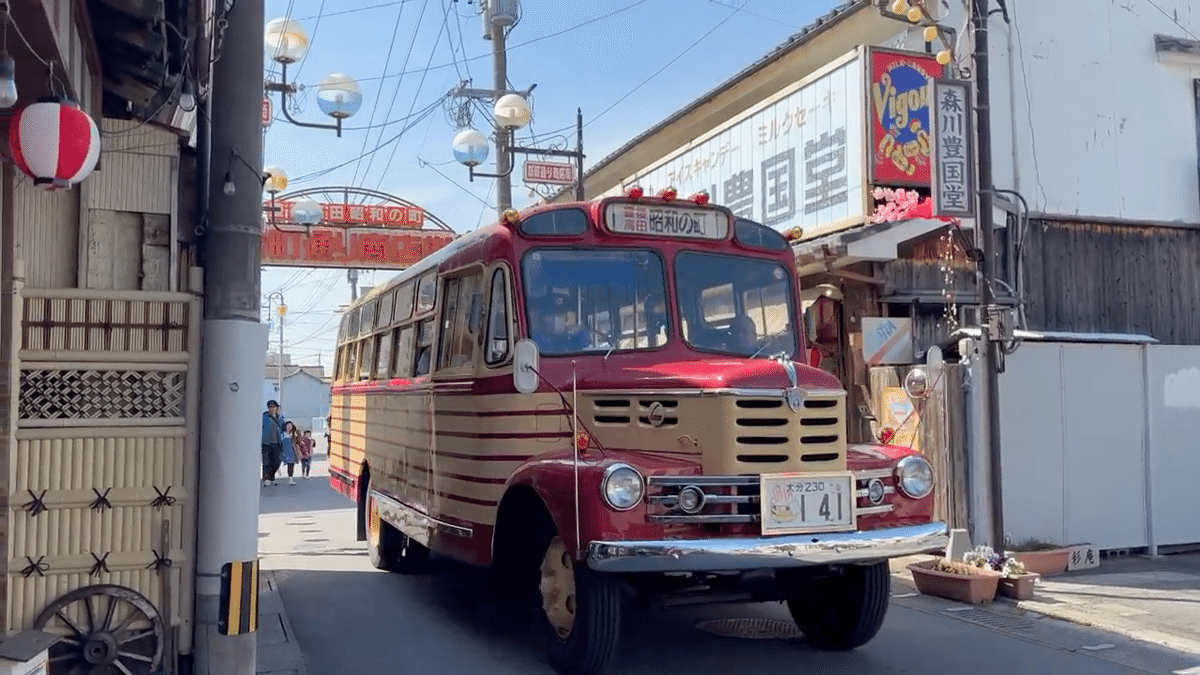
As I was strolling through the shopping street, a retro bus suddenly appeared before me. The sight of the huge bonnet bus slowly passing through the narrow shopping street made my heart leap with excitement, and I couldn’t help but think, “I want to ride it too!”

This bus is the “Showa Roman-go,” a bonnet bus that runs through Showa-era town. It apparently operates mainly on Sundays and public holidays. It’s an Isuzu BX141 model manufactured in 1957, and is the oldest drivable bonnet bus in Japan. It’s an extremely valuable vehicle. The shape of the bus and the Isuzu emblem have been reproduced exactly as they were back then, giving it a very charming appearance.

I heard that you can ride the bonnet bus for free if you make a reservation in advance, so I immediately got on as the first passenger. The interior was uniformly blue and in very good condition. The atmosphere was completely different from modern buses, and my heart was racing the moment I stepped inside. Old buses have a very simple design, and there were photos of the bus before it was restored displayed inside (I received special permission in advance and took photos under specified conditions).


The old-fashioned vibrations and engine sounds were incredibly comforting. The bus entered the shopping street, and the atmosphere instantly became more reminiscent of the Showa era. It was a strange sight, almost like an image created by a generative AI. As the bus drove along, many passersby waved, creating heartwarming moments.

During the bus ride, the bus guide gave us a tour of the town, and her sharp wit was so unique that it made for a really fun time. It was a delightful 15 minutes that flew by.

Fried bread and whale cutlet, enjoyed in school lunches of the Showa era.


For lunch, we decided to try a menu that recreates school lunches from the Showa era. We visited a coffee shop that faithfully reproduces the menu from that time. From the outside, it looks like an ordinary cafe, but as you go further inside, a strange space appears with school desks lined up.

The menu includes beer and coffee, as well as the option to order individual school lunch items. After much deliberation, I decided to start by ordering a single serving of skim milk powder. I had often heard that skim milk powder tasted bad, but it seems to have been improved considerably and tasted much better now. This was my first time trying it, and it was easier to drink than I expected.


The set I ordered this time was packed with nostalgic dishes: soft noodles, meat sauce, fried bread, whale cutlet, and milkshake. The whale cutlet had a rather unique and lingering aftertaste. The school lunch tableware is also made of aluminum, faithfully reproducing the originals from back then.

The fried bread was delicious and served piping hot, as it was fried to order, and I was able to enjoy a taste I hadn’t had in a long time. Then, the nostalgic Milmake made an appearance. Apparently, it was a memorable taste that was only available a few times a year, but perhaps that’s why it remains so vividly in the memories of many people. The bottled milk also brought back such nostalgic feelings. It was a time when forgotten memories came flooding back one after another.


The shop has a school-like atmosphere, but it also has a roulette-style fortune-telling machine, the kind you often see in Showa-era coffee shops. The fortune slips are placed inside the balls, giving it a truly retro feel.
Endangered species: “raccoon cake”

After lunch, it was time for sweets. We stopped by a local cake shop in the shopping district. There was a wide variety of delicious-looking cakes, making it hard to choose. When you think of cakes from the Showa era, you think of butter cake. Butter cake was the one that caught my eye the most, and it was a “raccoon dog cake,” which is said to be an endangered species.

It’s an incredibly cute-looking, very sturdy raccoon-shaped cake made with plenty of chocolate. I felt a little guilty, but I started eating it headfirst. Apparently, due to the rising price of butter, it’s now more expensive than a regular cake, but it was very tasty, with plenty of butter inside.

A surprising discovery: carp swimming.


In this Showa-era town, nostalgic scenery still remains. At first glance, it looks like an ordinary townscape, but there is a stream where carp swim gracefully. The carp food is sold as a capsule toy, and the container itself has a nostalgic design, which is a nice touch. The moment the carp realize they will be fed, they gather with incredible speed, and for some reason, I could watch them forever; it was very soothing.

“Showa Roman Kura” – Experience life in the Showa era.

We also visited “Showa Roman Kura,” where you can experience life in the Showa era. The first thing that greeted us were nostalgic classic cars. Their unique designs, unlike those of modern cars, were eye-catching. Even the tiny, toy-like cars evoked a sense of romance.

For those who want to experience the Showa era more deeply, the paid museum area is recommended, so this time I purchased a combined ticket for both the Candy Museum and the 3rd Street Museum.


The first place we visited was the “Dagashi Dream Museum.” It was an even deeper world than the candy store we had just stopped by. From here on, it’s a paid area.

Upon stepping inside, I was immediately overwhelmed by the sheer volume of items. It felt like I was in a dream, or like I had wandered into a retro treasure chest.

The museum also had rideable exhibits, but due to weight restrictions, only children up to 10 years old could ride them. I was also impressed that the music playing was, surprisingly, Thomas the Tank Engine.


Apparently, this museum displays a staggering 60,000 retro items. The objects, created during a time of economic prosperity, still seemed to shine brightly even today. It was a space filled with the warmth of analog, something you don’t find in today’s digital age.


The Showa Dream Town 3rd Street Museum recreates life from that era.

Next, we visited a free-to-enter elementary school classroom. The level of realism was so high that it felt like you could almost hear the children’s voices.

At “Showa no Yumemachi 3-chome-kan,” life in the 1950s (1955-1964) is faithfully recreated. This era marked the beginning of Japan’s rapid economic growth and a dramatic improvement in the quality of life for the Japanese people. In the free area, goods featuring designs from the Showa era are sold, and their unique and charming designs are said to be popular with today’s younger generation. There are also several recreated candy stores, which are rarely seen these days, allowing visitors to truly experience how candy was sold in the past. Even just the free area offered plenty to satisfy.


Next, we went to the paid area. At “Showa Dream Town 3rd Street,” the nostalgic atmosphere of the evening is recreated, and the lighting is designed to change according to the time of day (morning, noon, and night). In this area, you can actually play with toys from the Showa era. It was a space that the whole family could enjoy, where children could play with toys and adults could immerse themselves in nostalgia. There was also a corner where you could play with the original Famicom, and I tried what looked like a tennis game. I didn’t really understand how to play or which player I was controlling, but I still had a very enjoyable time.


Experiencing life in a Showa-era house

Further on, we entered an area that faithfully recreated a Showa-era house. It was a scene that anyone who remembers the Showa era would likely find nostalgic. This cluttered, chaotic feel is precisely what makes it so authentically Showa. It was so realistically recreated that it wouldn’t be surprising if someone actually lived there.

The trash cans have also been recreated exactly as they were back then. Apparently, there was no concept of sorting garbage at the time, and about 80% of the garbage was simply buried in landfills. It must have been incredibly inconvenient, yet somehow life back then feels more fulfilling than it is today, which is quite不思議 (mysterious/strange).

There was also an appliance that looked like a washing machine on display, and the “Toshiba” logo brought back such nostalgic feelings. Looking at them side by side like this, I really feel that there were overwhelmingly more things back then than there are now. It was perhaps the complete opposite of today’s era where minimalism is the mainstream. The refrigerator was also filled with nostalgic treasures, and when I found an ice maker that was just as it was back then, I couldn’t help but exclaim in delight.


The experience included actually being able to make a call using the black rotary phone. This experience, along with everything else, made me want to come back to this place again if I ever visit Oita.

In conclusion

As evening approached, the shops began to close one after another, and the crowds thinned out rapidly. With a sense of reluctance to leave, I too decided it was time to head home. In stark contrast to the minimalist trends of today, it was a world like a retro treasure chest, crammed with objects and memories. Bungo Takada, a real-life Showa-era town, is a place that continues to cherish and preserve such warm moments.

Places I visited
- Bungo Takada Showa Town (Bungo Takada City, Oita Prefecture)
- Station Street Shopping District
- Showa Roman Kura (Dagashi Dream Museum / Showa no Yumemachi 3-chome Museum)
- Bungo Takada City Showa Town Bonnet Bus “Showa Roman-go”
Comments